

THF vs Acetone: How Do Their Properties and Industrial Uses Differ?
The THF vs acetone question is rarely about which solvent is "better", but about which one fits the chemistry, the substrate and the drying profile of a given process. Both are clear, volatile, water-miscible industrial solvents, yet their polarity, solvency and handling risks differ enough that swapping one for the other can ruin a batch.
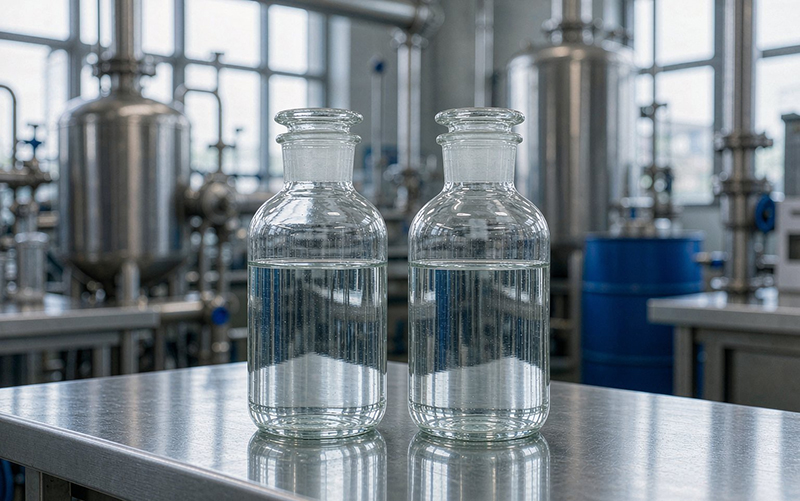
Both THF and acetone are clear, water-miscible solvents — but they behave very differently in formulation and in the plant.
THF vs acetone at a glance
Property | THF (tetrahydrofuran) | Acetone (propan-2-one) |
Boiling point | 66 °C | 56 °C |
Density | 0.89 g/cm³ | 0.79 g/cm³ |
Dielectric constant (polarity) | 7.6 | 20.7 |
Evaporation rate (n-BuAc = 1) | ≈6.0 — very fast | ≈5.6 — very fast |
Flash point (closed cup) | −14 °C | −20 °C |
Peroxide formation in storage | Yes — requires controls | No |
Dissolves PVC / polyurethane | Yes, strongly | Limited |
Typical cost | Higher | Lower |
THF solvent properties: polar, aprotic, aggressive
THF (C₄H₈O) is a cyclic ether with a low dielectric constant but a strongly coordinating oxygen atom. That explains most of its THF solvent properties: polar enough to dissolve a wide range of resins, aprotic enough not to quench carbanions, and fluid enough (≈0.48 cP) to keep high-solids masses mobile.
In organometallic chemistry THF solvates lithium and magnesium cations without killing the reactive species, so Grignard and organolithium reactions run faster than in diethyl ether; a freezing point of −108 °C keeps cryogenic steps workable. The same oxygen makes THF hygroscopic and prone to peroxide formation — store drums under nitrogen, away from light, and test for peroxides before distillation.
Tetrahydrofuran industrial applications
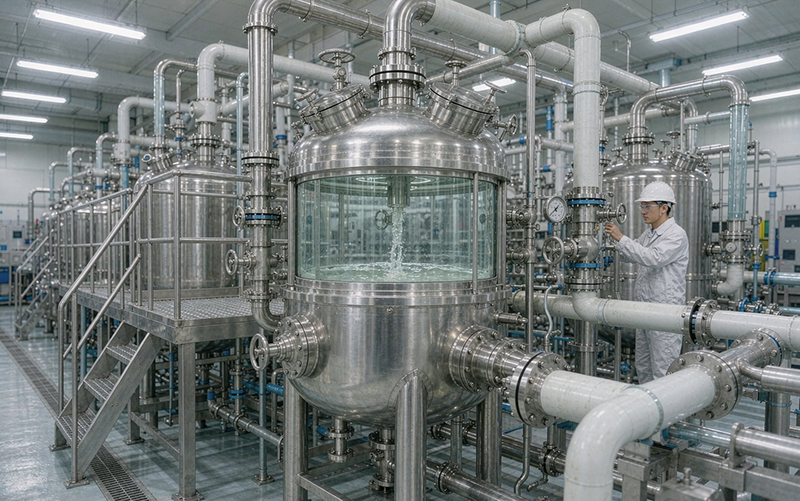
Reaction solvent duties in fine chemical and pharmaceutical plants are the largest single use of THF.
· Polymer manufacturing — the main outlet. THF is polymerised to PTMEG, the soft segment of spandex and thermoplastic polyurethane.
· Pharmaceutical and fine chemical synthesis — reaction solvent for Grignard, organolithium and hydride reductions, and for recrystallisation.
· PVC, polyurethane and vinyl processing — adhesives, pipe cements, plastic primers and printing inks.
· Electronics and analysis — electrolyte co-solvent, precision cleaning and GPC/SEC mobile phase.
Where acetone wins
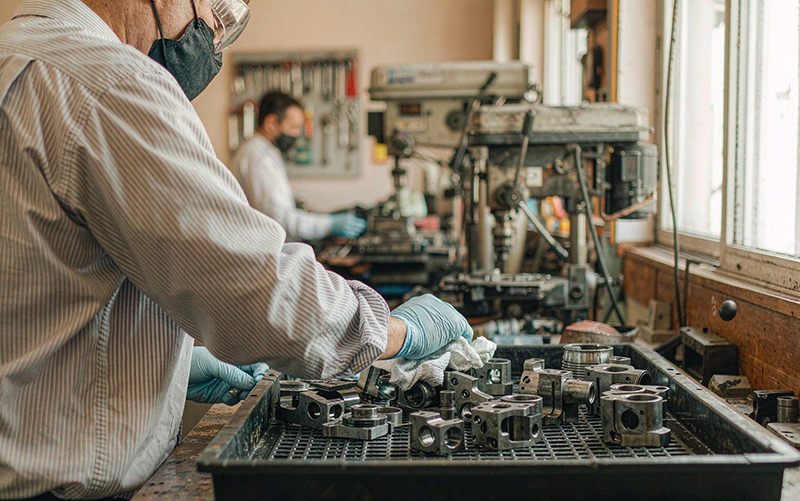
Surface preparation and equipment cleaning are classic acetone duties: fast, cheap and residue-free.
Acetone is cheaper, dries faster and is markedly more polar. That makes it the default for degreasing and wiping metal before coating or bonding, flushing spray guns, thinning polyester and vinyl resins, and cleaning glassware. Because it is fully miscible with water and does not form peroxides, open-process handling is simpler. Its weaknesses are equally clear: aggressive evaporation causes solvent pop and blushing on thick films, and it offers little solvency for PVC or high-molecular-weight polyurethane.
THF chemical compatibility: what it attacks
THF chemical compatibility is the most common cause of failure when a process is converted from acetone. For wetted parts, specify 316L stainless steel, PTFE, glass or fluoropolymer-lined equipment; avoid ABS, polycarbonate, polystyrene, rigid PVC, natural rubber, EPDM and most polyurethanes, which THF will swell, craze or dissolve within hours.
THF is also incompatible with strong oxidisers such as peroxides, perchlorates and nitric acid, and with strong acids or bases that can open the ether ring. Its low conductivity allows static build-up during transfers, so ground and bond every line and use Class 3 (UN 2056) compliant packaging and pumps.
How to choose between THF and acetone
1. Start with the substrate. Dissolving PVC, polyurethane or a vinyl copolymer means THF; degreasing metal or glass is usually an acetone job.
2. Check the drying profile. Both evaporate fast, acetone faster and with more surface cooling. Thick films and humid plants favour slower blends, not neat solvent.
3. Confirm material compatibility of tanks, hoses, gaskets, pumps and linings before the first transfer.
4. Quantify the handling burden. Nitrogen blanketing, peroxide testing and high-purity grades add cost that a low drum price hides.
5. Model total cost, not price per tonne. THF recovers well in closed loops; acetone losses in open cleaning are high but the unit price is low.
Buying THF and acetone in bulk
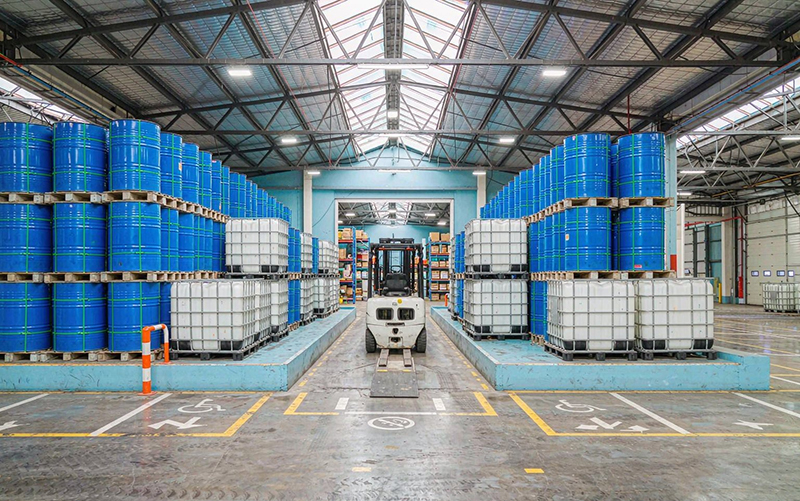
Packaging choice — drum, IBC or ISO tank — usually drives more cost than the headline solvent price.
Both ship in 200 L drums, 1000 L IBCs and ISO tanks. To qualify a THF supplier or compare industrial solvent supplier offers, ask for a lot COA (GC purity, Karl Fischer water, peroxide value, colour), the SDS in your language, registration status and the plant of origin. For THF, confirm the stabiliser and whether low-water (<500 ppm) material is available for organometallic work.
Frequently asked questions
Can acetone replace THF?
Only in cleaning and some coating applications. Acetone cannot replace THF in Grignard or organolithium chemistry, or where PVC and polyurethane must actually be dissolved.
Is THF more polar than acetone?
No — acetone has the higher dielectric constant (≈20.7 versus ≈7.6). THF is still polar and aprotic, and its cation coordination gives solvency for polymers and organometallics that acetone cannot touch.
Which one dissolves PVC?
THF. It is the basis of most PVC pipe cements and plastic adhesives. Acetone only softens PVC at the surface.
Which is the bigger safety concern?
Both are highly flammable (UN 2056 and UN 1090, Class 3). THF adds a peroxide hazard and attacks more plastics and elastomers, so it needs tighter storage and material controls.
Need THF or acetone for a production campaign? MarChem supplies both by drum, IBC and ISO tank, with lot-specific COA, stabiliser options and support on compatibility and recovery. [Request a bulk quote](/contact/?product=thf-acetone) · [THF product page](/products/tetrahydrofuran/)
Related reading: [How to Choose MEK for Industrial Coatings and Adhesives](/news/choosing-mek-coatings-adhesives/)
