

1. Why TDI Still Dominates Flexible Foam (and What to Look For)
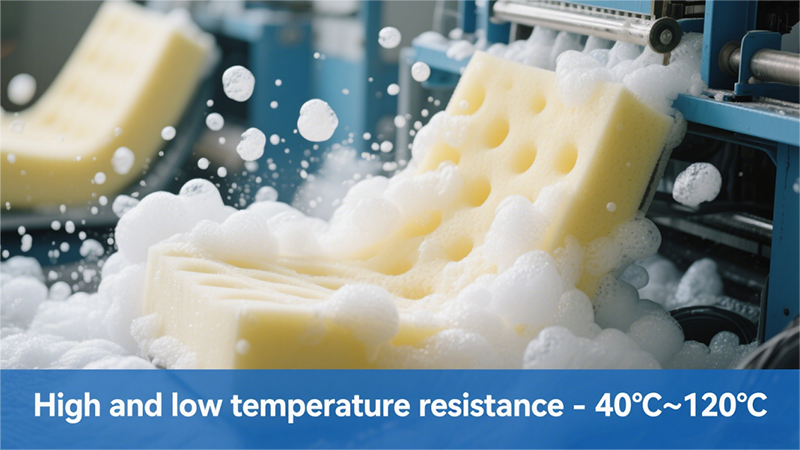
Flexible polyurethane (PU) foam — the material in mattresses, sofa cushions, automotive seats, and packaging — is most commonly made by reacting a polyether polyol with toluene diisocyanate (TDI) in the presence of water (chemical blowing agent), amine and tin catalysts, silicone surfactant, and optional flame retardants.
TDI's dominance comes from its unique differential reactivity: the 2,4-TDI isomer has one fast (para) and one slower (ortho) —NCO group, which lets the foam rise and gel in a controlled sequence. MDI-based systems exist (for high-resilience and molded foams), but TDI remains the cost-performance leader for conventional slabstock flexible foam.
If you are sourcing TDI for flexible polyurethane foam production, the decision is not just "buy TDI" — it is buying the right isomer grade, the right acidity/chloride spec, and a supplier whose batch-to-batch consistency protects your line uptime.
2. The TDI Grades Used in Flexible Foam
Grade | Isomer ratio | Typical foam use | Physical state |
TDI 80/20 (T-80) | 80 % 2,4 / 20 % 2,6 | Conventional slabstock — bedding, furniture, packaging | Liquid (freezes ~12 °C) |
TDI 65/35 (T-65) | 65 % 2,4 / 35 % 2,6 | HR (high-resilience) slabstock and molded premium foam | Liquid (freezes ~5 °C) |
TDI 100 (T-100) | ≥98 % 2,4 | Not standard for commodity foam; used in prepolymer-based / specialty systems | Solid below ~22 °C |
For 90 %+ of flexible foam producers — especially those running continuous slabstock bunkers — TDI 80/20 is the default specification. This guide focuses on TDI 80/20, with notes on when TDI 65/35 enters the picture.
3. TDI 80/20 Specifications for Foam Manufacturing
Below is the reference specification range drawn from major producer TDS documents (Hanwha KONNATE T-80, Dow VORANATE T-80, BASF). Use it as a baseline for your purchase specification; the supplier's current COA governs each shipment.
3.1 Product identity
Item | Value |
Chemical name | Toluene diisocyanate (mixture of 2,4- and 2,6-TDI) |
CAS No. (mixture) | 26471-62-5 |
EINECS | 247-062-0 |
UN No. | UN 2078 |
Molecular formula | C₉H₆N₂O₂ |
Molecular weight | 174.2 g/mol |
NCO content (theoretical) | ≈ 48.2 wt % |
Isocyanate equivalent weight | ≈ 87.1 g/eq |
3.2 Quality specification (buy this, not just "TDI")
Parameter | Unit | Typical spec | Test method | Why it matters in foam |
Purity | wt % | ≥ 99.7 | — | Higher purity = more consistent NCO charge |
2,4-TDI content | % | 80 ± 1 | ASTM D4660 | Sets the reactivity balance; drift shifts cream/rise time |
2,6-TDI content | % | 20 ± 1 | ASTM D4660 | Moderates crosslinking, keeps cells open |
Acidity (as HCl) | ppm | ≤ 15 (Type I) / 80–100 (Type II) | ASTM D5629 | Controls catalyst demand; Type II = retarded / slower pour |
Hydrolyzable chloride | ppm | ≤ 40 (Type I) / ≤ 120 (Type II) | ASTM D4663 | Affects prepolymer/chain-extend stability and foam aging |
Total chloride | ppm | ≤ 180 (Type I) / ≤ 700 (Type II) | ASTM D4661 | Bulk impurity marker |
Color (APHA / Pt-Co) | — | ≤ 15 | ASTM D4877 | Excess yellowing = degraded TDI; matters for white foam |
Viscosity @ 25 °C | mPa·s | ≈ 3.1 | — | Low; feeds standard metering pumps |
Specific gravity @ 25 °C | g/cm³ | 1.22 | — | For drum/tank volume conversions |
Flash point | °C | 135 (closed cup) | — | Handling/storage classification |
Freezing point | °C | 11.5 – 13.5 | — | Winter logistics threshold |
Vapor pressure @ 25 °C | mmHg | ≈ 0.03 | — | Ventilation / fume-extraction design |
3.3 Typical flexible slabstock foam formulation reference
This is a starting point — your polyol system, catalyst package, and target density will drive the actual numbers.
Component | Parts by weight |
Polyether polyol (OH # 54–56) | 100 |
Water (blowing agent) | 3.0 – 4.5 |
Silicone surfactant | 0.8 – 1.5 |
Amine catalyst (e.g., Dabco 33-LV) | 0.1 – 0.3 |
Tin catalyst (e.g., T-9 / stannous octoate) | 0.15 – 0.30 |
TDI 80/20 | index 105 – 115 (NCO index) |
Physical blowing agent (optional, e.g., methyl formate / acetone) | 0 – 10 |
Typical processing times on a continuous bunker: cream 8–15 s, rise 60–120 s, gel 90–180 s.
4. Selecting the Right TDI Grade for Your Foam Product
4.1 Match grade to foam type
Your product | Recommended TDI grade | Reason |
Conventional slabstock mattress (polyether, density 18–35 kg/m³) | TDI 80/20 Type I | Standard, fast-rise, high line output |
Economy furniture foam (density 16–25 kg/m³) | TDI 80/20 Type I or II | Type II if you need slower pour for wide-width buns |
HR slabstock / premium mattresses | TDI 65/35 (or T-80/T-65 blend) | Higher resilience, better load-bearing |
Molded automotive seat | TDI 80/20 (with molded-grade polyol) or T-65 | Good flow and demold |
Packaging / reticulated / open-cell foam | TDI 80/20 | Cost-optimized, open-cell structure |
Cold-cure / integral-skin | TDI 80/20 or modified MDI blend | Depends on system house |
Foam for light-colored / white goods | TDI 80/20, color ≤ 15 APHA | Avoid yellow-buff discoloration |
4.2 Type I vs Type II acidity — choose by your line, not by price
· Type I (low acidity, ≤15 ppm HCl, ≤40 ppm hydrolyzable Cl): faster reaction, more catalyst-active. Best for high-speed continuous slabstock where line throughput drives economics.
· Type II (controlled acidity, ~80–100 ppm HCl): deliberately retarded. Best for pour-in-place, slow-rise systems, or wide buns where you need more flow time before gel.
· Do not swap without re-catalyzing. A Type II TDI in a Type I formulation will under-rise and collapse; a Type I in a Type II system will gel prematurely and split.
4.3 When to consider TDI 65/35 instead
If your foam needs higher resilience, better compression set, or softer hand-feel (premium mattresses, automotive comfort), TDI 65/35 — with its higher 2,6-TDI fraction — gives a more flexible polymer network. It freezes at ~5 °C, so it handles more easily in winter than T-100, but it is a smaller-volume grade and may carry a price premium.
5. Supplier Evaluation: What "Industrial TDI Supplier" Should Actually Mean
For a foam plant, a TDI supplier is only as good as batch consistency and logistics. Evaluate on these criteria:
5.1 Documentation per shipment
· Certificate of Analysis (COA) showing every parameter in §3.2 — not just purity. Reject suppliers that only state "TDI 80/20, 99.5 % min."
· Safety Data Sheet (SDS) current to GHS / REACH format.
· MSDS / transport documentation for UN 2078 (Class 6.1, packing group II).
5.2 Regulatory compliance by destination
· China domestic: GB/T standard, factory production license.
· Sea freight: IMDG-classified packaging, UN-approved drums or tank containers.
5.3 Packaging options
Pack | Net weight | Best for |
Non-returnable steel drum | 250 kg net (≈200 L) | Small-to-medium foam lines, trial lots |
IBC / tote | 1,000 kg | Mid-size users |
ISO tank / tank truck | 20,000 L | Large slabstock plants, dedicated unloading |
5.4 Quality consistency questions to ask
· What is the batch-to-batch range of 2,4-TDI % and acidity? (You want tight control, not just spec minima.)
· Can the supplier provide COAs from the last 3 shipments for review?
· What is the origin producer? (Major producers have tighter internal specs than blenders/traders.)
· What is the typical shelf life from manufacture date to your arrival?
· What is the minimum order quantity (MOQ) for drums vs tank containers?
5.5 Logistics and storage on your side
· TDI 80/20 freezes at ~12 °C. In winter, confirm cold-chain or heated container shipping if transit may go below 12 °C. Frozen TDI is recoverable (warm to 20–30 °C, homogenize), but delayed.
· Store sealed under dry nitrogen blanketing at 15–30 °C. Moisture ingress = CO₂ pressure buildup and ruined product.
· Use dedicated, dry pumping equipment; never reuse water-contaminated drums.
6. Red Flags in a TDI Quote
Red flag | What it means |
"TDI 80/20, 99 % min" with no isomer %, acidity, or chloride specs | Trader-grade, unknown origin — high risk of line disruption |
Price significantly below major-producer market | Likely off-spec, re-blended, or aged stock with degraded NCO |
No Type I / Type II designation | You may get either; catalyst balance will drift |
Cannot provide REACH / TSCA / SDS for your destination | Customs or regulatory block at arrival |
Drums without UN marking or batch number | Non-compliant for hazardous sea freight |
Storage temperature not specified | Product may have been heat-aged (high APHA color) |

