

Geographic pivot: emerging markets take the wheel
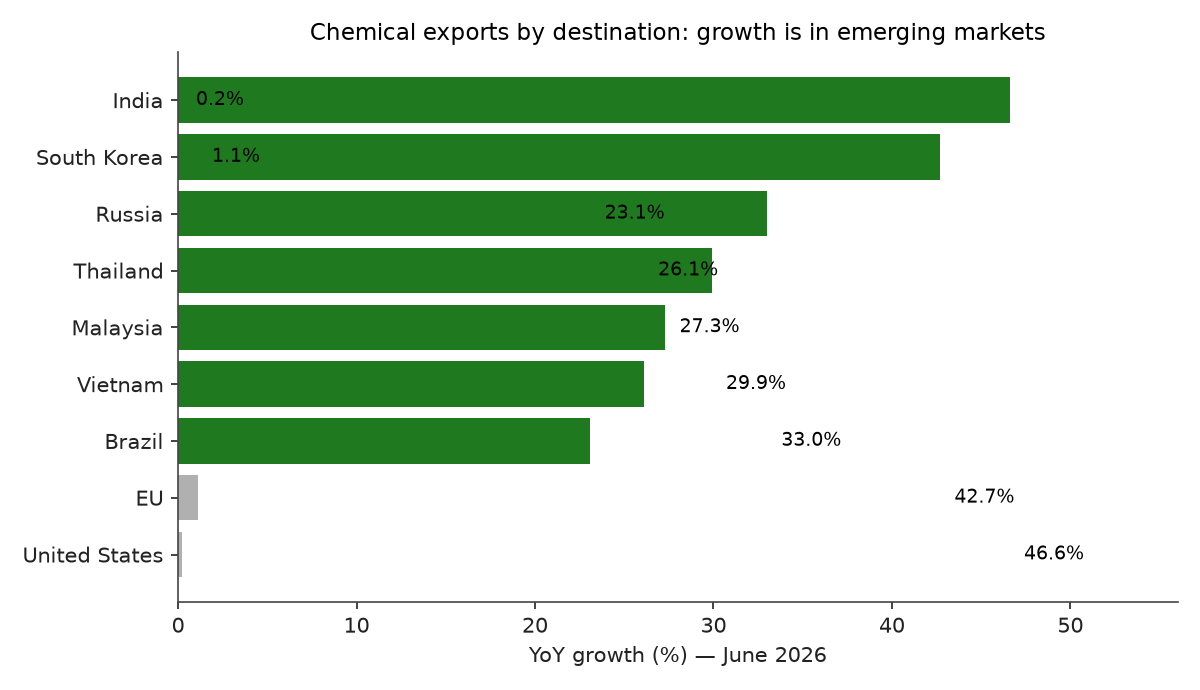
The destination map has shifted decisively. In June 2026, chemical exports to India rose 46.6% on the year, to South Korea 42.7% and to Russia 33.0%. Eight-month data tell the same story: Vietnam +26.1%, India +21.8%, Malaysia +27.3%, Thailand +29.9%, Russia +28.4%, Brazil +23.1%. The traditional anchors are flat: shipments to North America rose just 1.1% in aggregate, and to the United States specifically only 0.2% on a value basis of USD 215.9 billion across all goods.
Why are emerging markets absorbing so much? The short answer is that chemicals are intermediates, and intermediates follow downstream manufacturing. Apparel, footwear, electronics assembly, automotive components, packaging and white goods capacity has been migrating to South and Southeast Asia for a decade. The COVID shock, the US Section 301 tariffs, the EU carbon border and the reshoring subsidies of the Inflation Reduction Act have all accelerated that migration. Where the factories move, the chemistry moves with them. The Chinese exporter who in 2018 sold phthalic anhydride to a German resin compounder is increasingly selling to a Vietnamese compounder supplying a Samsung or Foxconn plant.
There is a second-order opportunity here that is easy to miss. As Chinese downstream companies — battery makers, panel producers, automotive parts suppliers, even petrochemical operators — establish overseas manufacturing, they pull Chinese chemical inputs with them. The order stickiness of an in-group supply chain is much higher than that of a third-party merchant trade. A polyester filament producer who builds a plant in Indonesia and ships purified terephthalic acid from Ningbo every three weeks is a fundamentally different customer than a trader. The first signs of this pattern are visible in Vietnam's Phu Tho and Hai Phong industrial parks, in Thailand's Eastern Economic Corridor and in India's Gujarat PCPIR.
Price versus volume: a volume-led cycle
One of the cleanest reads in the data is that the 2026 export cycle is volume-led, not price-led. The headline number captures value, but the value gain is overwhelmingly coming from tonnage. Average butadiene export prices fell from RMB 14,653 per tonne in May to RMB 12,365 in June even as export volume hit a record. Vinyl acetate, ethylene glycol and methanol showed similar patterns. The price softening in June is partly a base effect (overseas supply partially returning as Hormuz tension eased mid-quarter) and partly a result of the rush-to-export behaviour ahead of the April 1 export tax rebate reform (covered in detail in Part Two of this series).
This matters for two reasons. First, gross margin pressure on Chinese exporters is real and growing, even as their top line accelerates. Producers that have hedged feedstock and have logistics optionality are keeping margin; producers running on spot naphtha and single-port loading are not. Second, for international buyers, the current cycle is one of the best purchasing windows in five years. Spreads between Chinese FOB and regional delivered prices are wide enough that, after netting freight and the new carbon-related duties, landed cost in many European and South Asian destinations is at or below 2023 levels. Buyers who locked in Q3 and early Q4 orders at these levels will see material input cost relief in their 2026 P&L.
Outlook for Q4 2026 and into 2027
The fourth quarter is shaping up as a transition. Three forces will dominate.
First, restocking. Global downstream chemical inventories have been drawn down through the Hormuz shock. Polyester, packaging, automotive coatings and white-goods end-markets all show inventory days below the five-year average. As freight rates normalise and Middle East risk premia compress, a global restocking cycle is likely to begin in late Q4 and run through Q1 2027. The base case from CITIC and Huatai Securities is for full-year 2026 chemical exports to finish at +11–14% on a value basis and +15–18% on a volume basis, with a strong carry-over into early 2027.
Second, policy. The April 1 export tax rebate reform (the cancellation of VAT rebates on 80+ chemical SKUs including methanol, BDO, PVC, ethylene glycol and lithium hexafluorophosphate, plus the phasedown of battery rebates) is a structural margin event. Producers of the affected SKUs will see a roughly 9–13 percentage point hit to export gross margin if they cannot pass the cost through. In the short term, this accelerates the rationalisation of marginal capacity, which is supportive for the surviving producers. In the medium term, it pushes investment downstream — toward polymers, fine chemicals and formulations where the rebate is preserved or has not yet been removed.
Third, geopolitical risk remains. Hormuz traffic has partially resumed but the underlying tension has not resolved. Any new disruption would re-ignite the same trade flows that drove the June spike. Equally, a US trade action against Chinese chemicals — a long-running Section 301 review concluded in early 2026 with new duties on select categories — could redirect flows and disrupt the geographic pivot described above. The most likely scenarios for Q4 are continued mid-single-digit value growth, single-digit volume growth, and elevated volatility in petrochemical prices.
The coal-to-chemicals cost edge, in numbers
A specific reason the Q4 2026 base case is constructive for Chinese olefin producers is the structural cost gap with naphtha-based producers elsewhere. A coal-to-olefins (CTO) integrated site in Inner Mongolia or Shaanxi produces ethylene at a fully-loaded cash cost of approximately USD 750–850 per tonne in 2026, against USD 950–1,100 per tonne for a naphtha cracker in Korea or Singapore, and USD 1,050–1,250 per tonne for a European steam cracker buying naphtha at Brent-linked prices. The gap has widened in 2026 because the international naphtha marker has risen with crude, while Chinese thermal coal has been range-bound. The CTO cost edge translates into a per-tonne ethylene export offer that is roughly USD 150–300 below the marginal alternative, even after freight and any applicable CBAM cost. The same arithmetic applies, with different absolute numbers, to coal-based MEG, methanol and propylene. The implication is that the supply-chain re-rating visible in the customs data is not a one-quarter event. It will persist as long as the coal-naphtha spread remains wide, which most integrated energy models expect through at least 2028.
Capacity additions and the next supply wave
China added approximately 12 million tonnes per year of new ethylene capacity in 2024–2025 and is on track to add another 8–10 million tonnes in 2026–2027, predominantly through ethane-cracking and CTO/MTO routes. Propylene capacity additions are tracking at a similar pace. Most of this new capacity is designed for export-grade product specifications, and most of it is being built in coastal Shandong, Guangdong and Fujian locations with direct port access. The supply wave will keep Chinese export offers competitive through 2027 and will, in some sub-categories, reverse the price increases seen in 2025. The categories most exposed to this new supply are LLDPE, MEG, polypropylene homo-polymer and styrene. The categories less exposed are the performance polymers and specialty intermediates where new capacity is more limited and the qualification cycle longer.
Conclusion
The first three quarters of 2026 will be remembered as the moment China's chemical export complex moved from being the world's largest commodity supplier to becoming the world's swing supplier. The shift was driven by an unusual combination of geopolitical disruption, structural European weakness and aggressive Chinese cost discipline. The growth is real but concentrated. The opportunity for international buyers is material. The risk for unprepared exporters is equally real. The articles that follow in this series will look at the policy and regulatory environment that is reshaping these flows — and at the practical compliance steps that chemical exporters need to take before year-end.
