

The two engines: geopolitics and cost
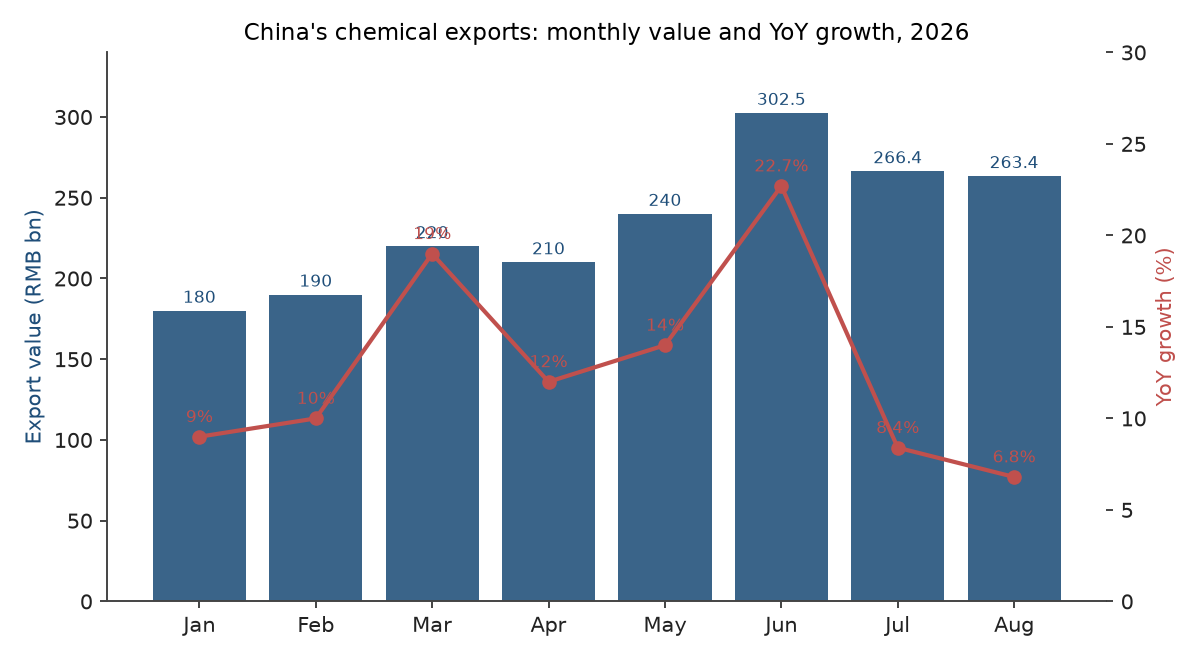
Two macro forces did the heavy lifting. The first is geopolitical. The closure of the Strait of Hormuz from late February 2026, triggered by the widening Middle East conflict, removed an estimated 20% of globally traded chemical supply from the market. Steam crackers in South Korea, Japan and Singapore that depend on naphtha and LPG shipped through the Gulf were forced into unplanned turnarounds; downstream butadiene, ethylene oxide and aromatics units throttled back. Chinese producers, many of them coal-to-chemicals integrated complexes in Inner Mongolia, Shaanxi and Xinjiang, ran at near-full utilisation through the same period and absorbed the displaced demand.
The second force is the persistent cost gap. European chemical manufacturing has been losing competitiveness for four consecutive years. Cefic and ICIS data show that roughly 9% of European chemical capacity was permanently shuttered between 2022 and 2025, and the attrition has not stopped — additional ethylene, MMA and specialty chemical facilities have been announced for closure through 2026. German verbund sites in particular are running at 75–80% utilisation versus 90%+ in the prior decade. With Henry Hub-linked US gas and coal-linked Chinese feedstock both significantly cheaper than Brent-linked European naphtha, Chinese export offers landed in Rotterdam and Mumbai at spreads wide enough to move tonnage even after freight and the new EU carbon border cost.
The result is the volume mix we see in the trade data: butadiene shipments of 34,700 tonnes in June (versus 13 tonnes a year earlier — the comparison base was almost zero because Northeast Asian producers dominated global supply in 2025), ethylene glycol exports of 97,600 tonnes (+1,020% YoY), vinyl acetate at +1,035%. These are not normal growth rates. They are one-off base effects compounded by a real gap that is unlikely to close quickly even if Hormuz traffic normalises.
Hot products: where the growth actually lives
| Product | HS chapter | Export momentum | YoY change | Key destinations | Driver |
| PBAT (biodegradable resin) | 39.07 | Sharp up, export-share 60% | +48.6% | EU, Vietnam, Indonesia | Plastic restriction rules, packaging demand |
| MMA (methyl methacrylate) | 29.16 | Strong, share rising | +57.5% | India, South Korea, Turkey | Optical sheet, coatings, EV glazing |
| MTBE | 29.09 | Surging, share 61% | +115.3% (June) | Singapore, Malaysia | Gasoline blending, tight regional supply |
| Sucralose | 29.24 | Near-fully exported | +37.0% | US, Mexico, UK | Health sweetener reformulation |
| Maleic anhydride | 29.17 | Strong | +53.9% | India, Southeast Asia | UPR, lubricant additives |
| Butadiene | 29.01 | Base-effect spike | +635.6% (H1) | South Korea, Taiwan | ABS, synthetic rubber downstream |
| Ethylene glycol | 29.21 | Base-effect spike | +1,020% (June) | Vietnam, Indonesia | Polyester, PET bottle-grade |
| Vinyl acetate | 29.15 | Base-effect spike | +1,035% (June) | Europe, Southeast Asia | EVA, adhesives, textile emulsion |
| Lithium iron phosphate | 28.39 / 38.15 | Surging | +657% (June) | Europe, US, Korea | EV battery cathode |
| Bisphenol A | 29.07 | Off a low base | +1,071% (Aug) | India, Thailand | Polycarbonate, epoxy resin |
| PVC | 39.04 | Steady, large base | +21.82% (H1) | India (904kt), Vietnam, Turkey | Construction, pipe, cable |
| PA6 (nylon 6) | 39.02 | Steady | n/a (flat volume) | Vietnam, Turkey, Italy | Engineering plastics, film |
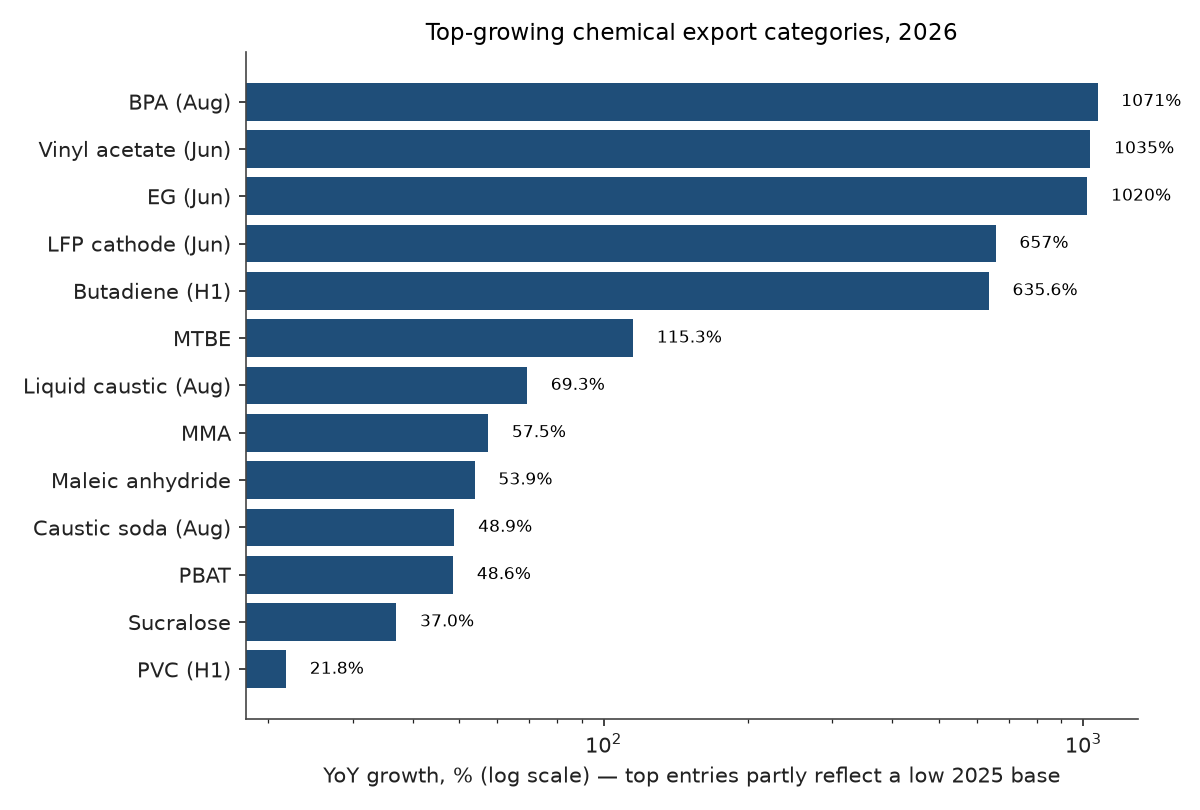
A few patterns jump out. First, the export-share leaders — PBAT (59.7% of domestic production now exported), MTBE (61.2%), sucralose (99.0%) and MMA (24.3%) — are the most vulnerable to any softening in overseas demand but also the most leveraged to any pickup. These are the categories that will swing the headline number most in Q4.
Second, the chlor-alkali chain turned a corner in August. Caustic soda flake exports rose 48.9% year-on-year, liquid caustic soda 69.3% and PVC 11.8%. Russian buyers in particular stepped in as Western buyers pulled back. This is consistent with the broader narrative of Russia sourcing intermediates and finished polymers from China at scale, a trade flow that has more than tripled since 2023.
Third, the lithium-ion battery supply chain continues to export. Lithium iron phosphate (LFP) cathode exports were up 657% year-on-year in June, and shipments of LFP-related precursors followed. The EV value chain is the second-largest contributor to incremental chemical export value after olefins, and unlike olefins it is still in a structural upcycle with new gigawatt-hour capacity coming online in Hungary, Morocco and Mexico that will need Chinese intermediates for the next 18–24 months.
